
Le Sueur County Active Warrants Explained
An active warrant, as Le Sueur County uses the term, is one the county's own list still shows as open. A judge signed it, and the table carries no mark showing it was served, recalled, or cleared. The listing is the county's publication, linked from the Sheriff's Office, so it reflects what that office knows. It does not stretch to every warrant in Minnesota. The list is free, public, and open to anyone who wants a Le Sueur County warrant lookup.
The Live Le Sueur County Warrant Table
Check the top of the table for a last-run date, because that stamp moves from visit to visit. One look showed a Tuesday run; the next day's visit showed the next day. That stamp is the best freshness clue the page gives, though it promises nothing. A warrant Le Sueur County officers already served can sit in the table until the next refresh. A brand-new one may be absent until the page runs again. So write the timestamp down along with the identifier before you call anyone. The county's listing sits here: Le Sueur County active warrant listing.
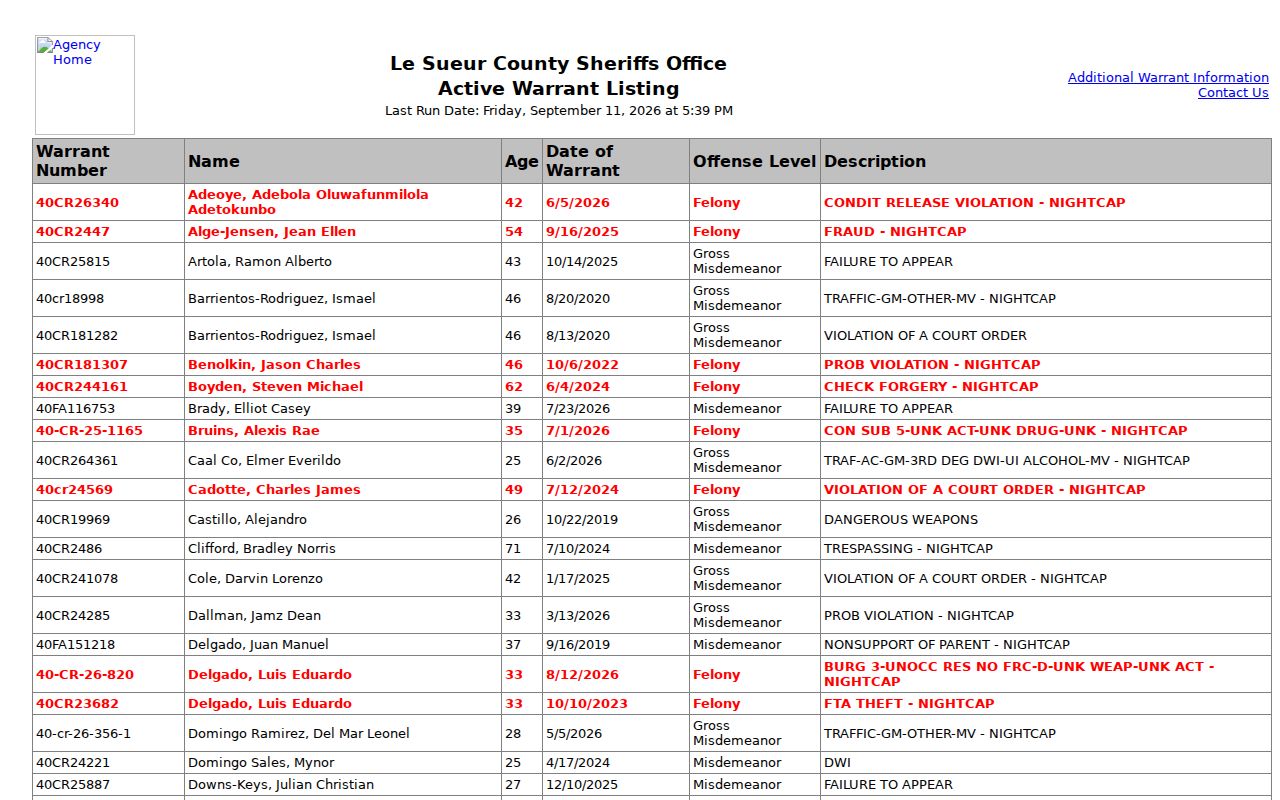
The Le Sueur County page is a plain table with no controls of any kind. That makes the run date at the top the only freshness marker a reader gets.
How Le Sueur County Tracks Active Warrants
The Le Sueur County Sheriff's Office builds the list from its own law-enforcement records and posts it as a static page. No filter, no sort, no export, and no result limit. Anyone hunting one specific warrant record does better to call the office directly than to work the page over.
Note: Absence from the live list is not proof that no warrant exists, and a row is not proof that one is still open.
Le Sueur County Warrant Offense Levels
A column in the Le Sueur County table labels each case felony, gross misdemeanor, or misdemeanor. Those labels only show how the list groups an offense. They describe nothing a court has decided, and nothing about any conviction.
- Felony
- The most serious offense-level label the county table uses.
- Gross misdemeanor
- The middle label, above a misdemeanor and below a felony.
- Misdemeanor
- The lowest offense-level label on the list.
- Active
- A page-level description, not a field value in the table.
- Outstanding
- Plain language for a warrant not shown as served or recalled.
- Recall
- A court action that withdraws the warrant.
Inside an Active Warrant Record
Each Le Sueur County row publishes seven fields and stops there. You will not find the signing judge, service attempts, or the date of a recall anywhere in the table.
| Warrant Number | Identifier in the state's county-code, case-type, year, and sequence shape, shown here as CC-CR-YY-NNNNN. |
|---|---|
| Charge / Offense | The offense-level label, such as felony or gross misdemeanor. |
| Issuing Court | Le Sueur County District Court for criminal and traffic cases filed in the county. |
| Bond Amount | A figure or hold label, set case by case. The county publishes no bond schedule. |
| Status | No status column exists. Served and recalled statuses come from the court or the sheriff. |
| Description | A broad reason or category shown by the list, not a charging document. |
Le Sueur County Warrant List Status
The word active comes from the page's own framing, not from any field. No column says active, served, or recalled, so a row alone cannot tell you whether an officer served the warrant last night or a judge recalled it this morning. The court register and the sheriff's records hold that answer. A call is what reaches it. Court access rules matter here as well. An arrest warrant index can stay confidential until the person is in custody, the warrant is served, or the person appears in court. That rule is one reason a public Le Sueur County page cannot promise a complete view of every outstanding warrant.
Warrant Roundups and Most-Wanted Lists
The Le Sueur County Sheriff's Office also keeps a separate Most Wanted program page for public-safety notices. That program covers a small, curated set of cases. Its linked document carries a revision date and a weekday update note. It is not the full county table, and it is not a warrant database.
Key Point: The Le Sueur County Most Wanted program page holds the official list and the official document.
Entries change as warrants are served or recalled, so the agency page is the only current source. The most wanted list page describes how the program works.
Jail Roster Versus Le Sueur County Warrants
Le Sueur County publishes a jail roster, and visitors often mistake it for a warrant lookup. It answers a different question. The roster lists people in custody at a jail licensed for 80 beds. Custody and an active warrant are separate facts. Someone can sit in the jail with no open warrant, and an outstanding warrant can exist for a person the jail has never held. There is no bond counter schedule to find there either. The county posts its Le Sueur County Jail page for custody questions.
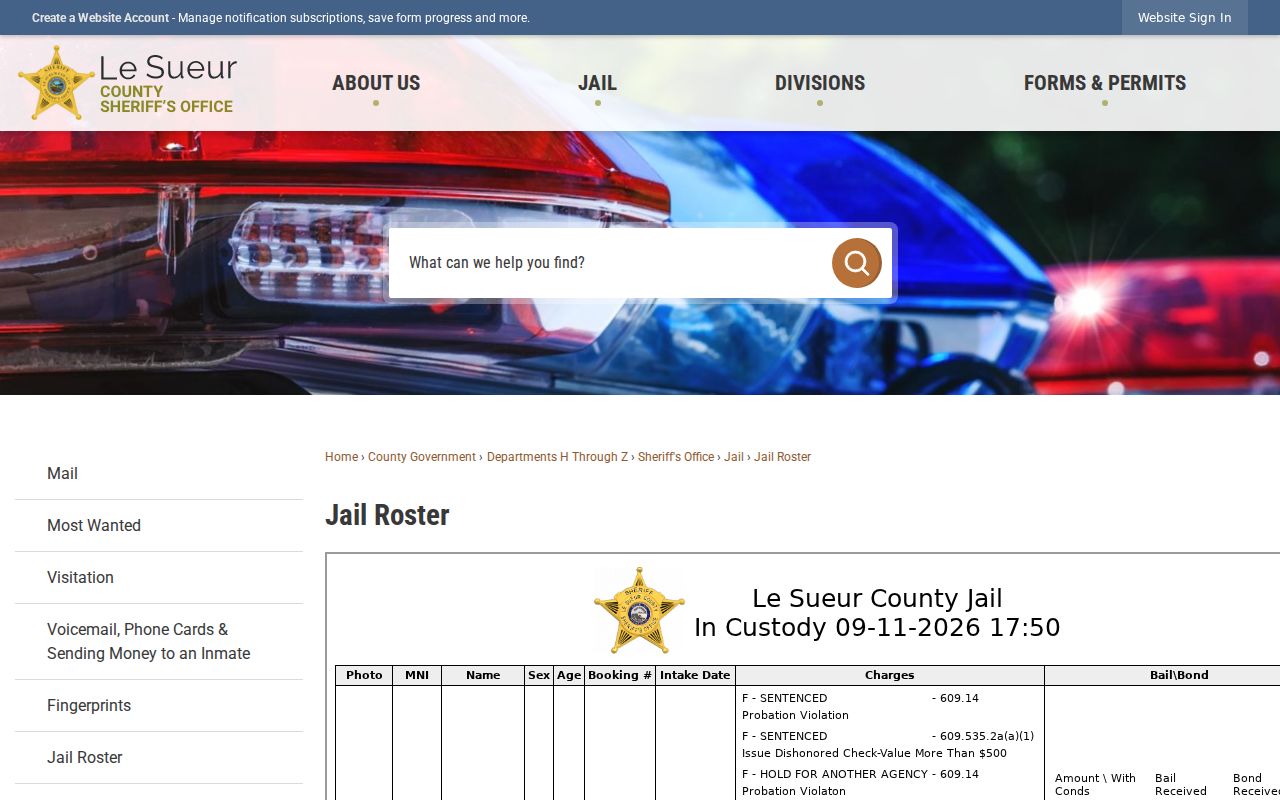
In Le Sueur County, custody and warrant status do not track each other. A bench warrant can stay open while its subject walks free, and an inmate can be held with no warrant at all.
Note: Ask the court or the sheriff about a warrant, and ask the jail about custody, because the two offices answer different questions.
When Your Name Is on the Warrant List
Spotting your own name on a Le Sueur County warrant list is a moment for a phone call, not a lone decision. Three lawful routes exist. You can surrender voluntarily, post bond, or ask the court to recall or quash the warrant. A lawyer can tell you which fits, since the court sets bond case by case and publishes no schedule.
Important: Talk with an attorney before turning yourself in. An open warrant can lead to arrest during a traffic stop or any police contact.
Confirming a Le Sueur County Warrant Match
Call the Sheriff's Office at 507-357-4440 with the identifier and the run timestamp you noted. Ask whether the warrant is still active and which office controls the next step. Then contact Le Sueur County District Court at (507) 357-8260. Ask the clerk about the case, the appearance route, and how a recall works. Write down what both offices tell you. If the matter is an eligible citation, the Court Payment Center takes payment and sets up payment plans, and a known case number makes that call go faster. The state case search can confirm your case number before you dial.