
Checking for a Warrant in Montgomery
Three offices can touch one Montgomery case. Each answers a different question, so work from the record you already have in hand.
- Find the citation or case number on the notice.
- Ask the police department for the police report if a city officer wrote the ticket.
- Search the number in Minnesota Court Records Online.
- Open the county active warrant listing and note the run timestamp.
- Call Le Sueur County District Court at (507) 357-8260 about the case and any appearance.
Note: Montgomery publishes no city warrant list, so the county table and the court carry every warrant question.
Montgomery Police Department's Service Hours
Montgomery runs a full-service police department around the clock, with Chief Nathan Hintz listed as the public official. Patrol coverage never stops, but the records and lobby side does. Lobby hours attached to the police contact information end late morning on Friday and run through the afternoon on other weekdays. Anyone needing a report copy should call ahead rather than assume the Montgomery front desk is staffed at midnight.
Montgomery Police and Municipal Court
The city has a police department but no municipal criminal court. Officers investigate and cite, and the case gets filed with the Minnesota district court covering the county. For a Montgomery matter, that means Le Sueur County District Court. The department posts its contact details and hours on the Montgomery Police page.
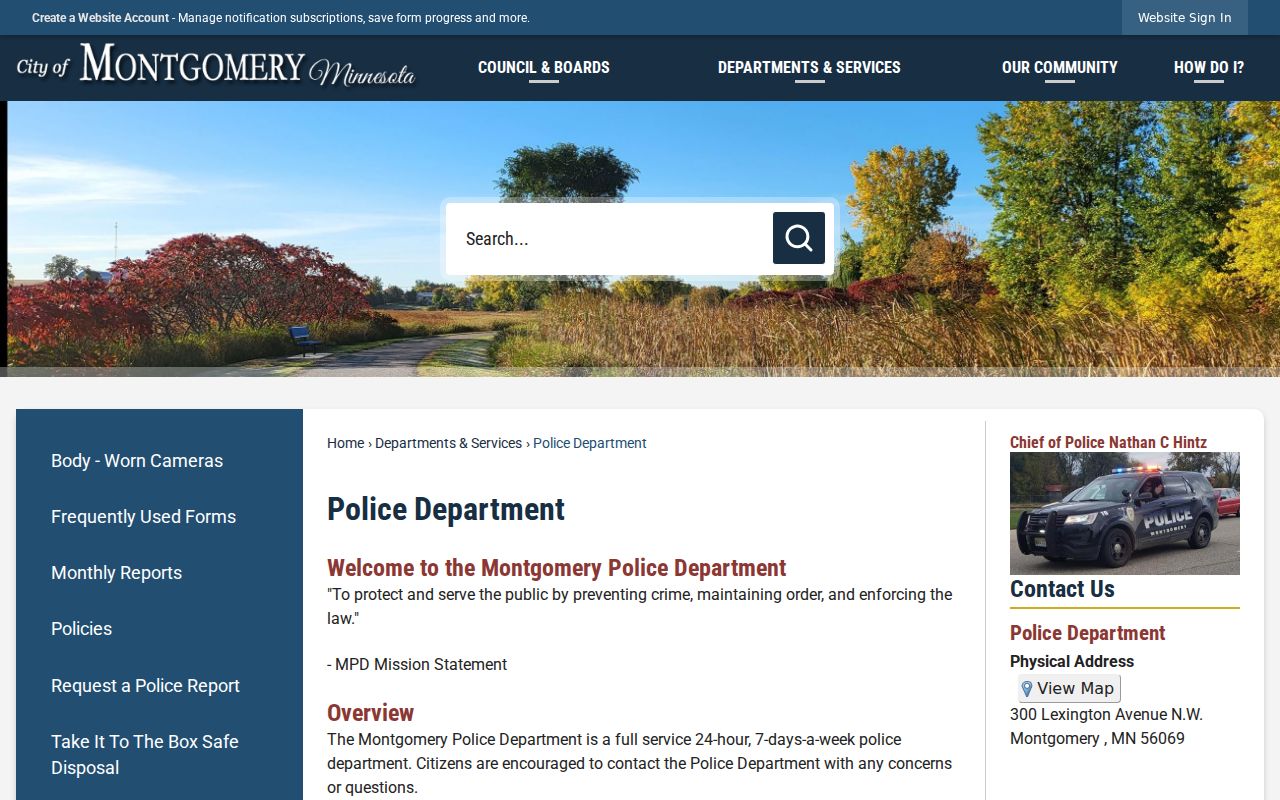
That page is the right first stop for a Montgomery police record and the wrong stop for a court date.
Montgomery Police Department
300 Lexington Avenue NW
Montgomery, MN 56069
507-364-8000
Le Sueur County District Court
Justice Center, 435 E. Derrynane Street
Le Center, MN 56057
(507) 357-8260
The 201 Ash Avenue Administration Counter
City administration sits in the municipal building on Ash Avenue and runs a phone line separate from the Montgomery police station. The office takes licensing, permits, utility questions, and general city business. It is not a records desk for police reports, and it has no role in a court case. Call the wrong number and you usually get redirected, which costs a day. The administration page is published at Montgomery administration.
Knowing which Montgomery building answers which question is the whole point of keeping the two contacts apart.
Montgomery Warrant Types
A Montgomery ticket or charge follows the state's warrant categories, and each type starts in a district court case.
| Warrant Type | How It Arises | Who Issues It |
|---|---|---|
| Traffic warrant | An unpaid or unanswered citation | The district court |
| Ordinance warrant | An unresolved city code matter filed in court | The district court |
| Bench or FTA warrant | A missed court date in an open case | The judge on that case |
| Arrest warrant | A charge supported by probable cause | A judge |
| Release-condition warrant | An alleged violation of release terms | The judge on that case |
Montgomery City Code and Traffic Chapters
The city code gateway covers traffic and public protection material along with the rest of the ordinance book. Those chapters define what counts as a local violation and what an officer may enforce inside Montgomery. They do not create a city warrant, and they give no clerk authority over a court file. Court records and the city code live in different places, so a reader who needs one should not expect the other. The code is published at Montgomery city code.
Reading the local Montgomery rule is useful context, and the case itself still belongs to the court.
Inside a Montgomery Warrant Record
The record belongs to the court case. Its fields read the same way in Montgomery as anywhere else in the county.
| Case Number | Built from a county code, case type, year, and sequence, as in CC-CR-YY-NNNNN. |
|---|---|
| Issuing Court | Le Sueur County District Court. |
| Originating Agency | Montgomery Police, if a city officer filed the matter. |
| Offense | A traffic, ordinance, or criminal matter as filed. |
| Amount | A fine, fee, or bond figure set in the case. |
| Status | Held by the court. The county list shows no status column. |
Two Montgomery Phone Numbers and Their Jobs
The Montgomery police station and the municipal building publish separate main numbers, and readers mix them up constantly. The department number reaches the agency that wrote the ticket and holds the report. The administration number reaches the office handling city business. Neither number reaches the court. A citation question involving a deadline, a fine, or an appearance has to go to the district court or the state payment center, whichever the Montgomery case requires.
How Montgomery Warrants Fit the County System
A Montgomery case joins the same county path as every other city's. The district court issues the process, the Sheriff's Office serves it, and the county list publishes a row when the sheriff chooses. No statewide system covers every county, so the county list and the court remain the two working sources.
Warrant flow: Montgomery Police › Le Sueur County District Court › County Sheriff › County list.
A Montgomery warrant check can start close to home, but the county holds the fuller file. For the whole picture, open the hub covering Le Sueur County warrant records, where every city route is laid out.
Why Montgomery Cases Go to County Court
City code enforcement does not create a separate court system, and Minnesota does not organize trial courts by city. That is why a local ordinance violation lands in the same courthouse as a state traffic charge. The city writes the rule and the citation, and the state court applies the law. The practical effect is simple. A Montgomery reader who wants a court outcome asks the county court, and a reader who wants the local rule reads the Montgomery city code.
Montgomery Warrant Records and Public Access
The state rules covering a court case also cover a city record, with one difference. A city police record sits under the same data practices law, but the office that responds is the city rather than the county.
Key Rules:
Minn. Stat. § 13.03 - Public data are the default, and a denial must cite a legal basis.
Minn. Stat. § 13.82 - Law-enforcement data and the arrest-warrant index.
Minn. Stat. § 260B.171 - Juvenile court records stay confidential.
Montgomery Records Requests and Warrant Files
A records request should name the office, the record type, and the date. A police report request goes to the department, which can usually match a date or an incident number. A court file request goes to the county court, where the clerk works from the case number. Neither request clears a warrant. A data request just produces a document, and only the court can change the legal status of the case.